A wise man once said, "One's mind, once stretched by an original idea, never regains its original dimensions". This is evident in our everyday life and can be a means by which you can improve everything around you. The idea need not be your own. As long as you understand the impact the idea has on your environment, as comprised by your location, state-of-mind, and relationships.
Perhaps at this point you may think I am being much too philosophical on a blog site about woodworking but, here is where I am going. It all comes back to what is commonly the last line of my posts here, "Enjoy! And look closely, please."
Look closely that your location. How did the things that surround you get there?
Look closely at your state-of-mind. Where is it taking you?
Look closely at your relationship to your environment. How do the places you spend the most time make you feel? What is missing? What needs to be removed?
I encourage everyone to explore the ideas that are affecting their unique environment and, by all means, challenge them. It is by looking within, and understanding what is there, that we can begin to move forward in a positive direction.
A common bond we share is that we all want to feel good, comfortable and safe in our homes. It stands to reason then, that we should feel these things about the items we consume, particularly the "durable goods" that will be a part of our environment for a long time to come (at least that is our hope when we put down our hard earned dollars for them).
But when we purchase items that we know are below our standards, what are we really getting? More importantly, what are we contributing, to our community, society and personal well-being? If the item was produced over-seas, you, in the case of a sub-par item, just contributed future garbage to your community landfill while taking away the work of local craftspeople. You've told society that you value low price over quality. And have potentially compromised your own well-being (can you say lead poisoning?).
Again, heavy words backing up a picture of a bookcase. I do apologize for my bluntness, but I keep my sharp tools in the shop ;).
Did you notice the differences between those two bookcases? No, I'm not talking about what is on the shelves. Is one "softer" or "smoother". Is one bigger, deeper or taller? (a description of the differences is found at the end of this post) Why are the differences there? How do they make you feel? What would you change?
Perhaps this bookcase isn't something you would want in your house, but you still need somewhere to put all your books. You need something that suits you. And only you know what that is.
Now consider this....
We all know the best tasting meals come from our own gardens. There is something special about enjoying the spoils of your labor. Sometimes the only thing better is a meal from your neighbor's garden (all the spoils, non of the toils). Think about how a simple garden can transform your environment. How it can tie a community together, and if done on a small scale around the country, can have such a large impact on society. This doesn't mean everyone has to be a green thumb and no one is obligated to do anything. I intend only to shed light on those around us, and the actions they take, that in a small, and impressively significant, way, collectively benefit the world.
You deserve something special and you have the right to get it from anywhere you please. Look closely at your options, and how they effect everyone's environment.

We've all made millions, if not trillions, of decisions that got us to where we are now. It is the decision making process within that determines our path in life. Be yourself. Make your own decisions, and know that when you pick up one end of the stick, you automatically lift the other end as well.
The two pictures above show a newel post I built for our upstairs. I also built a half-newel for the opposite wall, the base that the balusters join into and the upper handrail. This project is just part of the "fingerprint" I will leave on this house. I couldn't be happier with the way it turned out.
I love building things, because I enjoy making people happy. I'm inspired to be, and build, my best by believing the result of my effort will be shared joy.
How can I make you smile today?
Enjoy LIFE!
And look closely, please.
David J. Ulschmid
Designer / Craftsman
~ Wisp Woods ~
Arlington, SD 57212
wispwoods@gmail.com
Bookcase differences - The bookcases are the same size in every way. The feet are different and the tops-front of the side panels are different. It was an original idea of mine, to make these changes, against the urging of my wife. I'm happy I did, and she is too. Now our world is different and, as always, I can't wait to see what is next.


 Posts
Posts


 Here is a picture of some face frames pieces prior to glue-up. The chalk markings on them are called "Cabinet Maker's Triangles". These keep the pieces organized and properly oriented during the milling and joinery stages.
 This has been my first project using loose tenons. I built my own horizontal mortising machine (more on that below) to make the matching mortises. This has been working great. It is so much fun to learn new methods of joinery, and I know I will be using this a lot in the future.


 Here is the front of the gate.
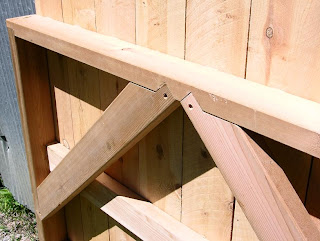
 No butt joints here, everything is accurately jointed and stainless steel screwed! Another excellent choice by my man Ben!